The intersection of a profound “national tragedy” and the volatile world of “presidential politics” has ignited a firestorm of controversy following the devastating deaths of legendary filmmaker Rob Reiner and his wife, Michele Singer Reiner. As the “entertainment industry” mourns the loss of the visionary behind The Princess Bride and A Few Good Men, a parallel narrative of “political polarization” has emerged. The discourse reached a fever pitch following a series of inflammatory statements from President Donald Trump, who opted to utilize his “Truth Social platform” to launch a blistering attack on the deceased director rather than offering the traditional “presidential condolences” expected during a “high-profile homicide investigation.”
The grim details of the case, which authorities have categorized as a “domestic violence double murder,” center on the couple’s Brentwood estate where they were found on December 14, 2025.1 Forensic reports confirmed that both Rob, 78, and Michele, 68, succumbed to “fatal knife wounds.”2 The investigation quickly pivoted to their 32-year-old son, Nick Reiner, who was taken into “police custody” shortly after the discovery.3 Reports from “celebrity news outlets” like TMZ suggest the incident followed a “volatile family dispute” at a holiday event hosted by Conan O’Brien, where witnesses described Nick’s behavior as “erratic” and “unstable,” a byproduct of a long-documented struggle with “substance abuse and mental health.”4
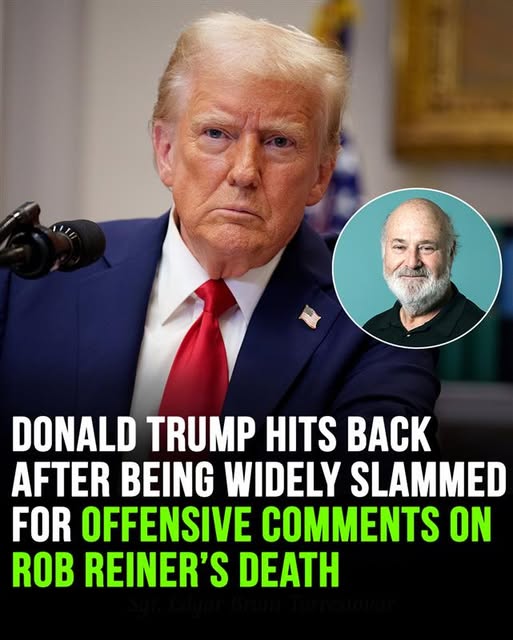
In the wake of this “unthinkable violence,” the public expected a moment of “national mourning.” Instead, Donald Trump, 79, shocked both supporters and detractors with a post that many categorized as “grossly offensive.” The President suggested that Reiner’s death was a secondary symptom of a “mind-crippling disease” he termed “Trump Derangement Syndrome” (TDS).5 Trump’s rhetoric implied that Reiner’s “political activism” and “anti-MAGA stance” had somehow manifested in the tragedy, stating that the filmmaker was “driven crazy” by a “raging obsession” with the current administration. This “unconventional communication strategy” has historically been a hallmark of Trump’s “digital brand,” yet the timing—coming mere hours after a daughter discovered her parents’ bodies—created an unprecedented “public relations crisis” for the White House.
The backlash was not confined to “liberal media circles”; it penetrated the core of the “MAGA movement.” In a rare display of “GOP dissent,” several high-profile Republicans and “Trump loyalists” publicly broke ranks. Georgia Representative Marjorie Taylor Greene, usually a staunch defender of the President’s “social media presence,” distanced herself from the remarks. She emphasized that the “loss of life” at the hands of a struggling son was a “private family tragedy” that should transcend “partisan politics.” Similarly, Kentucky Representative Thomas Massie challenged his colleagues to defend the discourse, labeling the President’s words as “inappropriate and disrespectful” toward a man who had just been “brutally murdered.”6
For “political risk analysts” and “reputation management consultants,” this rare instance of “intra-party criticism” highlights a potential “shifting tide in voter sentiment.” Even “three-time Trump voters” took to social media to express “moral disappointment,” urging the President to “humble himself” and recognize the “human dignity” required during a “capital crime investigation.” Despite this “reproach from the right,” Trump remained defiant. During a “media Q&A session” covered by the Associated Press, the President doubled down on his disdain. He referred to Reiner as a “deranged person” and a “friend of Russia,” invoking the “Russia hoax” narrative to justify his lack of empathy.7
Rob Reiner’s legacy as a “cinematic icon” is intrinsically tied to his “political advocacy.” As an “outspoken critic of the Trump administration,” Reiner frequently used “mainstream media interviews” to question the President’s “mental fitness for office.”8 In 2017, Reiner told Variety that Trump was the “single most unqualified human being” to hold the presidency.9 This “historical friction” between the two men has now become a central theme in the “post-mortem analysis” of Reiner’s life. “Biographical researchers” note that Reiner’s commitment to “democratic values” and “social justice” was as much a part of his “personal brand” as his “award-winning filmography.”
The “economic impact” of this controversy is also being felt in the “digital advertising” and “news media sectors.” Keywords such as “Rob Reiner murder update,” “Trump Truth Social backlash,” and “Nick Reiner arrest details” have seen “explosive search volume,” driving “organic traffic” to “true crime podcasts” and “political blogs.” This “monetization of tragedy” is a recurring theme in “modern journalism,” but the involvement of a sitting President adds a layer of “constitutional complexity.” “Legal scholars” are now debating the “ethics of presidential speech” and whether “inflammatory digital posts” could potentially prejudice a “fair trial” for Nick Reiner.
Simultaneously, the “entertainment world” continues to organize “memorial tributes” for the couple. “Hollywood royalty” and “industry executives” have largely ignored the President’s comments, choosing instead to focus on “philanthropic donations” in the Reiners’ names. The “Spinal Tap II” production, which Rob was recently helming, has become a focal point for “artistic remembrance,” with “streaming platforms” reporting a surge in views for his “classic films.” This “cultural resilience” serves as a counter-narrative to the “political vitriol” emanating from Washington.
As the “Los Angeles District Attorney” prepares the “prosecutorial case” against Nick Reiner, the “forensic evidence” and “eyewitness testimony” will take center stage. The “legal defense team” will likely examine “mitigating factors” such as “diminished capacity” and “chemical dependency,” issues that Nick himself explored in his “semi-autobiographical writing.” The intersection of “mental health advocacy” and “criminal liability” will be a “pivotal legal battleground” in the coming months, likely drawing “national media coverage” equivalent to a “high-stakes political trial.”
Ultimately, the “Trump vs. Reiner” saga underscores the “fractured nature of the American psyche” in 2025. It reveals a landscape where even “harrowing loss” is filtered through a “partisan lens.” While the President continues to prioritize his “anti-establishment rhetoric,” the rest of the country is left to grapple with the “grim reality” of a “beloved family’s destruction.” This “clash of values” between “political combat” and “communal empathy” will likely define the “electoral discourse” for the foreseeable future. The “Reiner family legacy” will undoubtedly endure through “masterful filmmaking,” but the “controversial circumstances” of their passing—and the “presidential response” that followed—have ensured that their story will remain a “flashpoint for debate” regarding the “future of American leadership” and the “preservation of civil discourse.”